

Pathways to Surgical Menopause
Surgical menopause, or the onset of early menopause following surgery, can stem from various causes. The management of your symptoms and health risks will depend on the specific procedure or treatment you undergo. Every woman’s journey is unique, and our goal is to help you find the necessary support and information throughout your experience.
It’s important to keep in mind that online forums tend to attract those who are struggling, as those doing well often don’t seek out support or share their stories. Your own experience may be quite different.
If you’re at the beginning of your journey and have yet to decide on surgery or the type of surgery you need, consult the sections Surgery 101 and Pre-Surgery to help answer your questions. If you’re freshly out of surgery, you can have a look at the section Post-Surgery.
Causes for Oophorectomy (Ovary Removal)
Common direct causes of oophorectomy may include:
- Ovarian tumours (benign, borderline or cancerous)
- Cancer prevention (BRCA1, BRCA2, HNPCC)
- Ovarian cysts
- Severe endometriosis (with or without adenomyosis)
- Premenstrual syndrome (PMS) or premenstrual dysphoric disorder (PMDD)
- Polycystic ovarian syndrome (PCOS)
- Gender-affirming surgery for trans men
A woman may have more than one surgery at different times in her life. When her last ovary is removed, she will automatically go into surgical menopause.
Other medical procedures can also induce early menopause by damaging nearby blood vessels and disrupting ovarian function, causing a sudden onset of menopausal symptoms.
Causes for Hysterectomy
A hysterectomy alone without the removal of ovaries, may sometimes trigger menopause symptoms – although for most women this is not the case. However, ovaries may stop working 2–3 years earlier than expected, and can temporarily go into shock after surgery, affecting hormone levels. Common causes for hysterectomy include:
- Uterine fibroids
- Endometriosis (with or without adenomyosis)
- Heavy menstrual bleeding (menorrhagia) that has not responded to other treatments.
- Endometrial or cervical cancer
- Enlarged uterus pressing on other organs
- Uterine prolapse
Types of Hysterectomy
Depending on the reason for surgery, all or part of the uterus may be removed. Types of hysterectomy:
- Subtotal or Partial Hysterectomy: The body of the uterus is removed, but the cervix is left in place.
- Total or Simple Hysterectomy: The entire uterus and cervix are removed.
- Radical Hysterectomy: The uterus, cervix, fallopian tubes, ovaries, possibly the upper part of the vagina, associated pelvic ligaments, and lymph nodes are removed.
- Hysterectomy with Unilateral or Bilateral Salpingo-Oophorectomy: The uterus, cervix, fallopian tubes and one or both ovaries are removed.
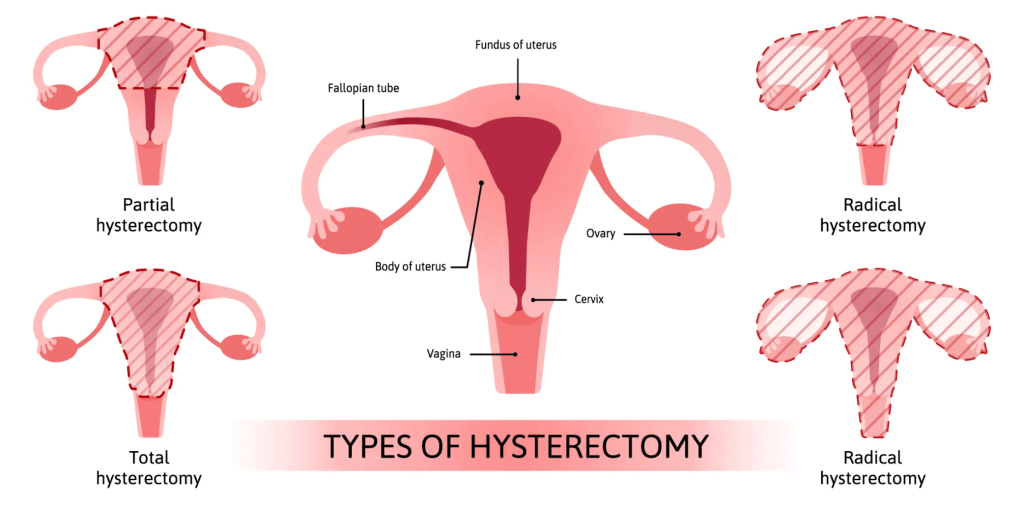
Image: © 2024 National Women’s Health Network. All Rights Reserved.
Other Medical Causes for Early Menopause
Impaired ovarian function can also stem from:
- Pelvic surgeries
- Cancer treatment (radiotherapy/chemotherapy)
- Certain medications
Pelvic Surgeries:
- Ovarian cystectomy: Removal of ovarian cysts can sometimes damage ovarian tissue and lead to reduced ovarian reserve.
- Endometriosis surgery: Extensive removal of endometriosis lesions, particularly from the ovaries, may impact ovarian function over time.
Cancer Treatment:
- Radiotherapy:
- Pelvic radiation can directly damage ovarian tissue, leading to premature ovarian failure.
- Even radiation to nearby areas, like the abdomen, can have a detrimental effect on ovarian function.
- The degree of damage depends on radiation dose and woman’s age.
- Chemotherapy:
- Many chemotherapy drugs are toxic to ovaries, particularly alkylating agents.
- Can lead to temporary or permanent loss of ovarian function.
- Effect varies based on drug type, dosage, and woman’s age.
Medication:
- Gonadotropin-releasing hormone (GnRH) agonists: GnRH are used to manage conditions like endometriosis and fibroids by reducing symptoms like pelvic pain, heavy or painful menstrual periods, and abdominal bloating. These medications work by lowering estrogen levels, which helps shrink the abnormal tissue causing these symptoms. GnRH agonists can induce a temporary menopause state.
- Tamoxifen: Used as a treatment for hormone receptor-positive breast cancer, tamoxifen can lead to menopause-like symptoms and may contribute to early menopause, especially in women closer to natural menopause age.
- Aromatase Inhibitors: Drugs like anastrozole, used to treat breast cancer, work by reducing estrogen levels, potentially leading to early menopause.
It’s important to note that the impact of these factors can vary greatly between individuals. Some may cause temporary impairment, while others can lead to permanent ovarian dysfunction.
Keeping Up with Recommendations
Medical practices and surgical guidelines evolve, and it’s essential to stay informed. For instance, opportunistic oophorectomies during hysterectomies were once common, but since 2008, this practice has been largely discouraged due to the crucial role ovaries play in overall health and quality of life, as well as the potential risks associated with their removal.
Keeping up with changing guidelines can be challenging, even for medical professionals. Take the time you need to thoroughly explore your options, and don’t hesitate to ask questions. Seeking a second opinion can also provide clarity. Making an informed decision requires careful research and open communication with your healthcare providers.
While surgical or early menopause can be daunting, not everyone has a difficult experience. Surgery may bring relief, with some individuals experiencing minimal symptoms and feeling better or unchanged. Being well-informed and aware of potential risks can help you navigate the recovery process and the years that follow with confidence and peace of mind.
References
Zachary E, Rocca WA, Carin YS, Rocca LG, Stewart EA, Laughlin-Tommaso SK, Mielke MM. Time Trends in Unilateral and Bilateral Oophorectomy in a Geographically Defined American Population. Obstet Gynecol. 2022 May; 139(5): 724–734. https://www.ncbi.nlm.nih.gov/pmc/articles/PMC9015031/
Australasian Menopause Society, Surgical Menopause, Dec 2024.
Australasian Menopause Society, Early Menopause due to Chemotherapy and Radiotherapy, Sept 2020.
British Menopause Society, Surgical Menopause: A Toolkit for Healthcare Professionals, May 2021.
Huang Y, Wu M, Wu C, Zhu Q, Wu T, Zhu X, Wu M, Wang S. Effect of hysterectomy on ovarian function: a systematic review and meta-analysis. J Ovarian Res. 2023 Feb 9;16(1):35.
Zhang, S., Liu, Q., Chang, M. et al. Chemotherapy impairs ovarian function through excessive ROS-induced ferroptosis. Cell Death Dis 14, 340 (2023).
[Updated: 16 July 2025]
 Surgical Menopause New Zealand Trust